Latest F5CAB5 Exam Cost & Reliable Study F5CAB5 Questions
Wiki Article
Time talks. The passing rate for RealValidExam F5CAB5 download free dumps is really high. Our users do not worry about tests with our products. There was one big piece missing from the puzzle. As exams are very difficult and low passing rate, it will be useless if you do not purchase valid dumps. F5 F5CAB5 Exam Learning materials make you half the work double the things. Once you pass exam you will obtain a satisfied jobs as you desire.
F5 F5CAB5 Exam Syllabus Topics:
| Topic | Details |
|---|---|
| Topic 1 |
|
| Topic 2 |
|
| Topic 3 |
|
| Topic 4 |
|
| Topic 5 |
|
F5CAB5 Exam Torrent - F5CAB5 Practice Test & F5CAB5 Quiz Torrent
Nowadays F5CAB5 certificates are more and more important for our job-hunters because they can prove that you are skillful to do the jobs in the certain areas and you boost excellent working abilities. Passing the test of F5CAB5 certification can help you find a better job and get a higher salary. With this target, we will provide the best F5CAB5 Exam Torrent to the client and help the client pass the F5CAB5 exam easily if you buy our F5CAB5 practice engine.
F5 BIG-IP Administration Support and Troubleshooting Sample Questions (Q28-Q33):
NEW QUESTION # 28
A BIG-IP Administrator configured the following virtual server to pass traffic on all addresses and ports. After configuration is completed, the BIG-IP Administrator notices that the virtual server is unable to pass traffic.
ltm virtual forwarding_any_vs {
destination 0.0.0.0:any
ip-forward
mask 255.255.255.255
profiles {
fastL4 { }
}
serverssl-use-sni disabled
source 0.0.0.0/0
translate-address disabled
translate-port disabled
}
Which part of the configuration is the cause of the issue? (Choose one answer)
- A. Incorrect destination configured
- B. Incorrect mask 255.255.255.255
- C. Incorrect translate-address configured
Answer: B
Explanation:
This virtual server is intended to function as a forwarding (IP-forwarding) virtual server, which is commonly used for routing or firewall-style deployments where BIG-IP forwards traffic transparently without load balancing or address translation. For a forwarding virtual server to match and pass all traffic, the destination must be configured as 0.0.0.0:any with a mask of 0.0.0.0, not 255.255.255.255.
The configured mask 255.255.255.255 represents a /32 host mask, which restricts the virtual server to matching traffic destined only for the exact IP address 0.0.0.0. Since 0.0.0.0 is not a valid routable destination for normal traffic, no packets will ever match the virtual server, causing it to pass no traffic at all.
This is a well-documented BIG-IP behavior:
destination 0.0.0.0:any
mask 0.0.0.0
together define a catch-all forwarding virtual server.
The destination itself (Option A) is correct for a forwarding VS, and disabling address translation (Option C) is expected and required for IP-forwarding mode. Therefore, the incorrect subnet mask is the sole reason the virtual server is not functioning as expected.
NEW QUESTION # 29
During a high-demand traffic event, the BIG-IP Administrator needs to limit the number of new connections per second allowed to a Virtual Server. What should the administrator apply to accomplish this task?
- A. A OneConnect profile to the Virtual Server
- B. An HTTP Compression profile to the Virtual Server
- C. A connection limit to the Virtual Server
- D. A connection rate limit to the Virtual Server
Answer: D
Explanation:
F5 BIG-IP provides two distinct ways to throttle traffic on a Virtual Server: total capacity and velocity.
Connection Rate Limit: This setting specifically controls the number of new connection attempts per second. It is the correct tool for managing traffic spikes and protecting backend resources from being overwhelmed by a high frequency of new requests.
Comparison (Connection Limit): A standard Connection Limit (Option C) restricts the total concurrent connections allowed at any one time, regardless of how fast they arrive.
NEW QUESTION # 30
Exhibit: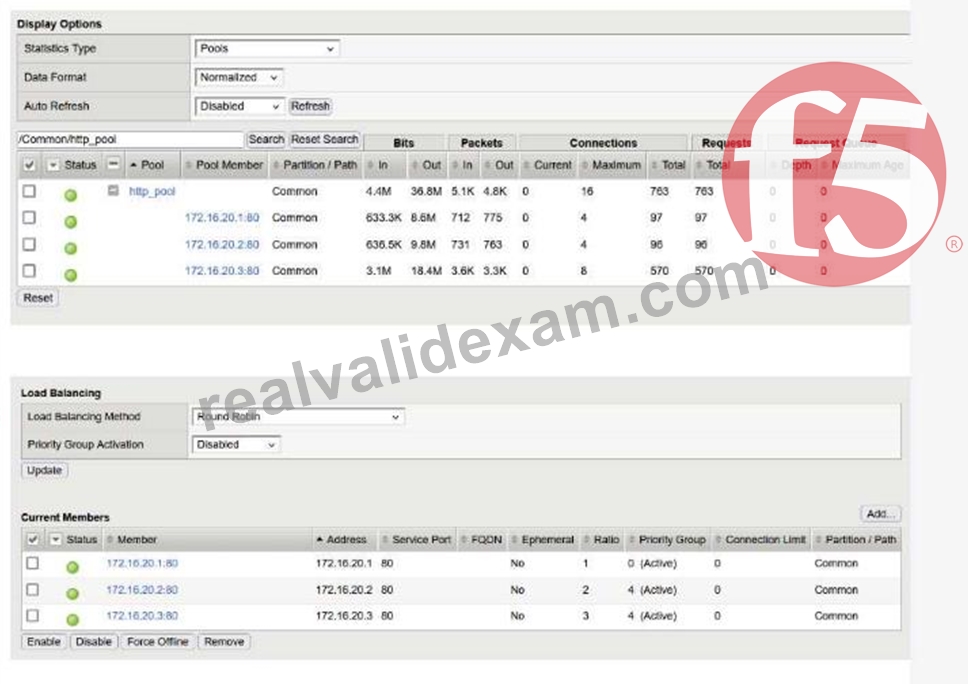
A BIG-IP Administrator configured a virtual server with a pool of 3 members and selected the Round Robin load balancing method to evenly distribute traffic across the pool members. During initial testing, traffic was not evenly distributed and the pool member 172.16.20.3 received more traffic than the other pool members.
Refer to the exhibit and the virtual server configuration provided below:
Plaintext
ltm virtual http.vs {
destination 10.10.1.100:http
ip-protocol tcp
mask 255.255.255.255
persist {
source_addr { default yes }
}
pool http.pool
profiles {
tcp{}
}
serverssl-use-sni disabled
source 0.0.0.0/0
source-address-translation {
type automap
}
translate-address enabled
}
What is the most likely cause of this behavior?
- A. Automap source address translation can cause uneven load balancing
- B. Pool members' ratio settings are causing the uneven traffic distribution
- C. A persistence profile assigned to the virtual server can cause uneven load balancing
- D. Round Robin requires an HTTP profile to work efficiently
Answer: C
Explanation:
The primary reason for the uneven traffic distribution is the presence of a Persistence Profile in the virtual server configuration.
Load Balancing vs. Persistence: While the Round Robin method is designed to distribute new connections sequentially among pool members, Persistence overrides this logic for existing clients.
Source Address Persistence: The configuration shows source_addr persistence is enabled. This ensures that once a client (identified by their source IP) is mapped to a pool member, all subsequent connections from that same IP will be sent to the same member for the duration of the persistence record.
Uneven Distribution Logic: If one source IP address generates significantly more connections or longer-lived sessions than others-or if many clients appear behind a single NAT/Proxy IP-that specific pool member (in this case, 172.16.20.3) will receive a disproportionate amount of traffic compared to the others.
Evaluating Other Options:
Automap (Option A): SNAT Automap changes the source IP between the BIG-IP and the pool member. It does not impact the BIG-IP's ability to load balance incoming client requests.
Ratio Settings (Option B): In the provided exhibit, the pool members have a Ratio of 1, 2, and 3 respectively. While a higher ratio does direct more traffic to a member, the question asks for the "most likely cause" in the context of the provided ltm virtual configuration, which explicitly highlights the persistence override.
HTTP Profile (Option C): Round Robin is a Layer 4 load balancing algorithm and does not require a Layer 7 HTTP profile to function.
NEW QUESTION # 31
Which process is most likely responsible for high traffic processing CPU usage?
- A. mcpd
- B. httpd
- C. snmpd
- D. tmm
Answer: D
Explanation:
TMM handles traffic processing and is usually responsible for high CPU under load.
NEW QUESTION # 32
Refer to Exhibit: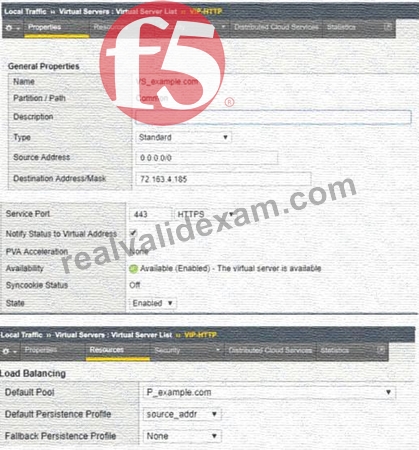
An organization is reporting slow performance accessing their Intranet website, hosted in a public cloud. All employees use a single Proxy Server with the public IP of 104.219.110.168 to connect to the Internet. What should the BIG-IP Administrator of the Intranet website do to fix this issue?
- A. Change Default Persistence Profile to cookie
- B. Change Load Balancing Method to Least Connection
- C. Change Fallback Persistence Profile to source_addr
- D. Change Source Address to 104.219.110.168/32
Answer: A
Explanation:
This scenario describes a classic network performance issue known as the "Mega-Proxy" problem. When an organization routes all employee traffic through a single proxy server, the BIG-IP sees thousands of unique users as having the exact same source IP address. If the administrator has configured "Source Address Affinity" persistence, the BIG-IP will correctly follow the rule but incorrectly route all users to the same single backend pool member. This creates a severe load imbalance where one server is overwhelmed while others remain idle, leading to poor application response times. To resolve this, the administrator must change the persistence profile to "HTTP Cookie". Cookie-based persistence allows the BIG-IP to place a unique identifier in each user's browser, allowing the system to distinguish between individual sessions even if they share the same source IP. This fix ensures that traffic is distributed evenly across the pool members, restoring4 the expect5ed load balancing functionality and resolving the slow performance reported by users behind the corporate proxy.
NEW QUESTION # 33
......
Laziness will ruin your life one day. It is time to have a change now. Although we all love cozy life, we must work hard to create our own value. Then our F5CAB5 training materials will help you overcome your laziness. Study is the best way to enrich your life. On one hand, you may learn the newest technologies in the field with our F5CAB5 Study Guide to help you better adapt to your work, and on the other hand, you will pass the F5CAB5 exam and achieve the certification which is the symbol of competence.
Reliable Study F5CAB5 Questions: https://www.realvalidexam.com/F5CAB5-real-exam-dumps.html
- F5CAB5 Relevant Questions ???? Reliable F5CAB5 Test Answers ???? F5CAB5 New Learning Materials ???? Search for 「 F5CAB5 」 and easily obtain a free download on 「 www.troytecdumps.com 」 ????Valid F5CAB5 Real Test
- Valid F5CAB5 Real Test ???? F5CAB5 Test Lab Questions ???? F5CAB5 Test Engine Version ???? Copy URL ➽ www.pdfvce.com ???? open and search for ⏩ F5CAB5 ⏪ to download for free ➡️F5CAB5 Exam Pass4sure
- Premium Quality F5 F5CAB5 Online dumps ???? Simply search for ➠ F5CAB5 ???? for free download on ▛ www.testkingpass.com ▟ ????F5CAB5 Relevant Questions
- Premium Quality F5 F5CAB5 Online dumps ???? Search for ▶ F5CAB5 ◀ and easily obtain a free download on ➠ www.pdfvce.com ???? ????F5CAB5 Latest Version
- How F5 F5CAB5 copyright is essential on your F5CAB5 Exam Questions Certain Success ⏸ Copy URL ➡ www.vce4dumps.com ️⬅️ open and search for ▛ F5CAB5 ▟ to download for free ????Test F5CAB5 Dates
- Valid F5CAB5 Test Sims ???? Valid F5CAB5 Real Test ???? F5CAB5 New Learning Materials ???? Enter ⏩ www.pdfvce.com ⏪ and search for ➽ F5CAB5 ???? to download for free ????F5CAB5 Latest Version
- How F5 F5CAB5 copyright is essential on your F5CAB5 Exam Questions Certain Success ⛷ Open ➥ www.testkingpass.com ???? enter ➠ F5CAB5 ???? and obtain a free download ????F5CAB5 New Learning Materials
- Hot F5CAB5 Spot Questions ???? Associate F5CAB5 Level Exam ☣ F5CAB5 Latest Test Preparation ???? The page for free download of ▛ F5CAB5 ▟ on { www.pdfvce.com } will open immediately ????Pdf F5CAB5 Free
- Quiz Fantastic F5CAB5 - Latest BIG-IP Administration Support and Troubleshooting Exam Cost ???? Simply search for ➽ F5CAB5 ???? for free download on ▷ www.examcollectionpass.com ◁ ????Valid copyright F5CAB5 Files
- Latest F5 - Latest F5CAB5 Exam Cost ???? Easily obtain ⏩ F5CAB5 ⏪ for free download through 【 www.pdfvce.com 】 ????Pdf F5CAB5 Free
- Valid F5CAB5 Real Test ???? Associate F5CAB5 Level Exam ???? Valid copyright F5CAB5 Files ⏸ Go to website ➤ www.pdfdumps.com ⮘ open and search for ▷ F5CAB5 ◁ to download for free ????Pdf F5CAB5 Free
- tasneembysr100846.blog5star.com, 210list.com, fellowfavorite.com, anitaffai859674.verybigblog.com, abelsqyy512988.bloggerchest.com, www.stes.tyc.edu.tw, orlandohbrf255877.blog2freedom.com, sidneyndii624409.bloggosite.com, karimjnhc910156.angelinsblog.com, adrianadevt320208.blogdeazar.com, Disposable vapes